How to Deglaze a Pan With Chicken Stock

A pan sauce is the perfect finish for a main dish, and it's simple to make! Use this tutorial, recipe and video to make a restaurant-quality finishing sauce at home!

This culinary technique involves creating a sauce from the flavorful brown bits left on the bottom of a skillet after searing meat, poultry or fish. It is very easy to make, and will truly elevate your cooking game.
That technique, my friends, is called a pan sauce. And I'm so excited to finally have a tutorial with step-by-step photos AND a video to show you how it's done!
If you're looking for other ways to raise the bar in your culinary creations, you should know how to perfectly carmelize onions and roast red peppers.
Another way to please a crowd with a savory treat is whipping up some crispy, oven cooked bacon!
Check out my full archive of cooking tutorials here!
Pan sauce ingredients
Ingredients, Notes + Substitutions
- Protein – Meat, poultry, and fish can all be used (you can even use tofu).
- Aromatics – Shallots, onions, and garlic can all be used to create this savory sauce.
- Deglazing Liquid – Any dry red or white wine, or brandy have acid, so they will work best. Orange juice and vinegar also work for the same reason.
- Stock – You can use any stock, but I highly recommend using a homemade stock if possible. A pan sauce has just a few ingredients, so you want all of them to be the best quality possible.
- Flour Dredge (optional for poultry or fish) – A flour dredge is optional, but it adds more flavor and crunch to poultry and fish. In addition to adding a crunchy coating, the flour will create more fond for flavoring the sauce.
- Fat – You use fat twice: Once for searing the meat, and then at the end to finish the sauce. To sear, you want a neutral-flavored, high smoke point oil (my favorites are clarified butter and grapeseed oil). You can use regular butter or cream during the final step.
- Additional Seasonings (optional) – This is where you can get creative if you want, adding ingredients like fresh herbs, spices, and condiments.
EQUIPMENT YOU'LL NEED
Skillet – Stainless steel, anodized aluminum, or enameled cast iron are the best choices. Do not use a nonstick pan! You won't get the brown bits, which are the entire point. I typically use a stainless steel skillet like this one. Enameled cast iron (like this pan from Lodge) is my second favorite option.
Firm Spatula or Wooden Spoon – You'll need something to scrape up the brown bits after deglazing. Don't use something soft like a silicone spatula. This is my favorite spatula for deglazing.
Recipe Video: How to Make a Pan Sauce
For this step-by-step tutorial, I'm using boneless, skinless chicken breasts. This is the best way to prepare chicken breasts if you want to amp up their flavor!
- Dredge the chicken.I recommend this step with chicken breasts and fish filets, but you definitely don't need to dredge steak. I set myself up for success using a pie dish for the dredge and tongs for the chicken. Dredge both sides, shaking off the excess flour.

- Sear the chicken. Sear over a medium high heat, using enough fat to add a light coating to the bottom of the dish.

Watch the pan, moving it off the heat if it looks like it's getting too smokey. Don't try to flip the chicken if it's sticking to the pan. It will detach once it's properly seared! Cook each side for several minutes, until the chicken is cooked through (165 degrees F on an instant read thermometer).
Once the chicken is golden brown on both sides, transfer to a clean plate or cutting board and tent loosely with foil. This will keep the chicken warm while you prepare the sauce or cook any remaining chicken.
- Add aromatics – Lower the heat to medium low and add the shallots, stirring to coat with brown bits. As they begin to cook, their natural liquid should help loosen the fond. A pinch of salt (optional) helps this process along. Cook for a few minutes, again making sure the brown bits aren't getting black.
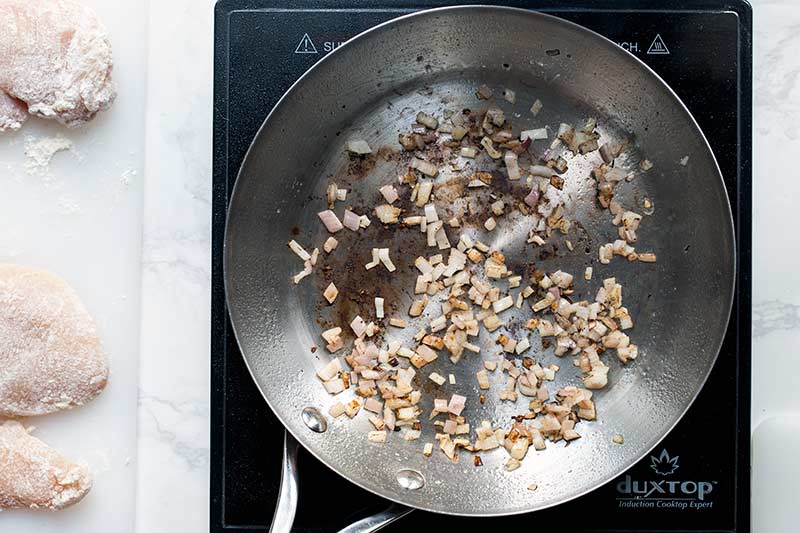
Cook for a few minutes, again making sure the brown bits aren't getting black. Cook for a few minutes until the shallots are soft and coated with brown bits, lowering the heat and removing the pan if it looks like the fond is getting too dark, Dark brown is fine, and if you wind up with a few black bits, the sauce will still be fine.
The photo above shows the fond getting about as dark as you want to let it get. A little lighter is even more ideal.
- Deglaze the skillet – Use 1/4 to 1/2 cup of liquid. Simmer the liquid, reducing it down until there's about 1 tbsp left.

For your safety, if you're using a deglazing liquid with alcohol and have a gas stovetop, I recommend removing the pan before adding the alcohol. When you add the liquid, it will simmer and steam. Get in there with your spatula and scrape up the fond!

- Add stock

Next, add the stock. If you notice any more brown bits of fond, Keep scraping up the bottom of the pan. This is where you can also add additional flavors like garlic and thyme (two of my favorite add-ins).
- Reduce the sauce

Simmer until the sauce is reduced by approximately 1/2. It should be thicker, but not super thick. See the above photo on the right. If you over-reduce your sauce (if it tastes too strong), you can add a couple tablespoons of water.
You can add additional flavors here like mustard or a sprinkle of cheese. See my section below on optional add-ins.
- Finish with butter or cream

Add 1-2 tablespoons unsalted butter or heavy cream to finish. This ties everything together, so don't skip it. Season with salt and pepper to taste.
Optional add-ins
Just a few ideas for additions to your sauce. Get creative!
- Whole or ground spices
- Fresh herbs
- Fruit juice
- Jam (strawberry, raspberry, etc)
- Balsamic vinegar
- Honey or maple syrup
- Soft cheeses (feta, goat, etc)
- Mustard
Pan Sauce Recipe Ideas
Here are a few ideas to get you started. All of these use approximately 4 chicken breasts.
Port Wine with Cranberries
- 1/4 cup shallot (1 medium), finely chopped
- 1 cup port wine
- 1 cup chicken stock
- 1/4 cup dried cranberries
- 2 tablespoons raspberry or strawberry jam
- 2 tablespoons unsalted butter
- Salt and pepper to taste
White Wine Tarragon Sauce>
- 1/4 cup yellow onion, finely chopped
- 1 clove garlic, minced
- 1/2 cup dry white wine (such as Chardonnay)
- 1 1/2 cups chicken stock
- 1 tablespoon fresh tarragon, finely chopped
- 1 tablespoon unsalted butter
- Salt and pepper to taste
Mustard Cream Sauce
- 1/4 cup shallot (1 medium), finely chopped
- 1/3 cup dry white wine (such as Chardonnay)
- 1 cup chicken stock
- 1/2 cup heavy cream
- 2 tablespoons Dijon mustard
- Salt and pepper to taste

Recipe notes
How to store leftover sauces
Store any leftovers in a covered container in the refrigerator for up to 5 days. Reheat it in a skillet or pour it over any leftover protein and warm it through in the oven.

Print Pin Recipe
Chicken Breasts with Pan Sauce
Learn how to make a pan sauce, one of the most incredible techniques you can master to step up your cooking game.
Course Main Course
Cuisine French
Keyword How to Make a Pan Sauce, Pan Sauce, Pan-Seared Chicken
Prep Time 5 minutes
Cook Time 10 minutes
Total Time 15 minutes
Servings 4
Calories 324
- 1 cup all-purpose flour (optional for dredging)
- Kosher salt and ground black pepper as needed
- 4 thin-sliced chicken breasts (or 2 butterflied chicken breasts)
- 1 tablespoon clarified butter or other neutral-flavored, high heat oil
- 2-3 tablespoons shallots, sliced or diced (yellow onions may be substituted)
- 1/4 cup red or white wine (brandy or cognac are also good; see notes)
- 1/2 - 3/4 cup chicken stock, homemade or low-sodium
- 1-2 tablespoons unsalted butter or heavy cream
- Optional Add-Ins: 1 spring of thyme 1 smashed garlic clove, 1 teaspoon dijon mustard (see notes)
- Optional garnish: 1-2 tablespoons chopped flat-leaf parsley
-
For dredged chicken: Stir together the flour, 1 1/2 teaspoons salt, and 1 teaspoon ground black pepper in a shallow dish (such as a pie pan). Using tongs, dip each piece of chicken in the flour mixture on both sides, shaking away any excess flour. Place on a cutting board or large plate.
-
For non-dredged chicken: Pat the chicken dry with paper towels, then place on a cutting board or large plate and sprinkle both sides with salt and pepper.
-
Cook the chicken: Heat a large skillet (stainless steel, aluminum, or enameled cast iroover medium-high to high heat. Add just enough clarified butter or oil to coat the bottom of the pan, then add the chicken. Don't touch it after it hits the pan. Let the chicken sear in one place for around 1-3 minutes, until brown and crispy. If you try to flip the chicken and it's sticking, that's ok. It means it's not ready to turn yet. As soon as the side is properly seared, it will detach.
-
Flip and sear the chicken on the other side for a couple more minutes until browned on the surface and cooked through (165 degrees F on an instant read thermometer). Transfer the chicken to a clean plate and tent lightly with foil to keep it warm while preparing the sauce.
-
Prepare the sauce: Pour off any excess fat (there might not be any here, but you'll run into this with fattier cuts of meat), but don't touch the brown bits on the pan. Place the pan back on the heat and turn it down to medium.
-
Add the aromatics: Add the shallots, using a firm spatula or wooden spoon to stir them around for 30 seconds to 1 minute. Keep an eye on the brown bits to make sure they're not getting to dark (you want caramelized, not burned), adjusting the heat or removing the pan from the heat as needed.
-
Deglaze the pan: Add the wine to the pan. It will sizzle and steam, but shouldn't totally evaporate (if it does, add a couple tablespoons of water). Immediately use your spatula to scrape up the brown bits from the bottom of the pan, incorporating them into the shallots and liquid. Let the liquid simmer and reduce by about half.
-
Add the stock: Add the chicken stock and any optional add-ins. Simmer until it's reduced to about 1/3 of the original amount.
-
Finish the sauce: Once the sauce is reduced, add button or cream to finish the sauce (or a 50/50 split). This will add depth, richness, and a glossy shine. Taste and add salt and pepper as needed. If the sauce tastes too strong (over-reduced), add 1-2 tablespoons of water to thin it out. If you added a spring of thyme, remove before serving. Pour the sauce over the chicken. Optionally garnish with chopped flat-leaf parsley.
All of the ingredients and quantities listed here should be considered guides. You can get as creative as you like with a pan sauce, using various cuts of meat, liquids, and seasonings. See my full post for examples as well as a few specific combinations to get you started.
I typically use a cabernet or chardonnay for pan sauces. If you don't want to use alcohol to deglaze the pan, I recommend using an acidic liquid like vinegar (apple cider, red/white wine vinegar, etc).
Please read my full post for additional recipe notes, tips, and serving suggestions!
Calories: 324 kcal | Carbohydrates: 26 g | Protein: 17 g | Fat: 9 g | Saturated Fat: 5 g | Cholesterol: 53 mg | Sodium: 90 mg | Potassium: 333 mg | Fiber: 1 g | Sugar: 1 g | Vitamin A: 104 IU | Vitamin C: 1 mg | Calcium: 10 mg | Iron: 2 mg
Recipe Troubleshooting
For immediate help troubleshooting a recipe, please email me using the form on my contact page. I'll try to respond to urgent questions as quickly as possible! For all general questions, please leave a comment here :)
How to Deglaze a Pan With Chicken Stock
Source: https://www.savorysimple.net/how-to-make-a-pan-sauce/
0 Response to "How to Deglaze a Pan With Chicken Stock"
Post a Comment